
APPLICATION WORKSHEET
Match Your Resume to a Job
Before applying for your next role, read the job description beside your resume. Check eligibility first, then find an example for each important requirement and note what still needs work.
Try this now: Highlight five requirements and label each: shown, unshown or not yet learned.
Understand resume review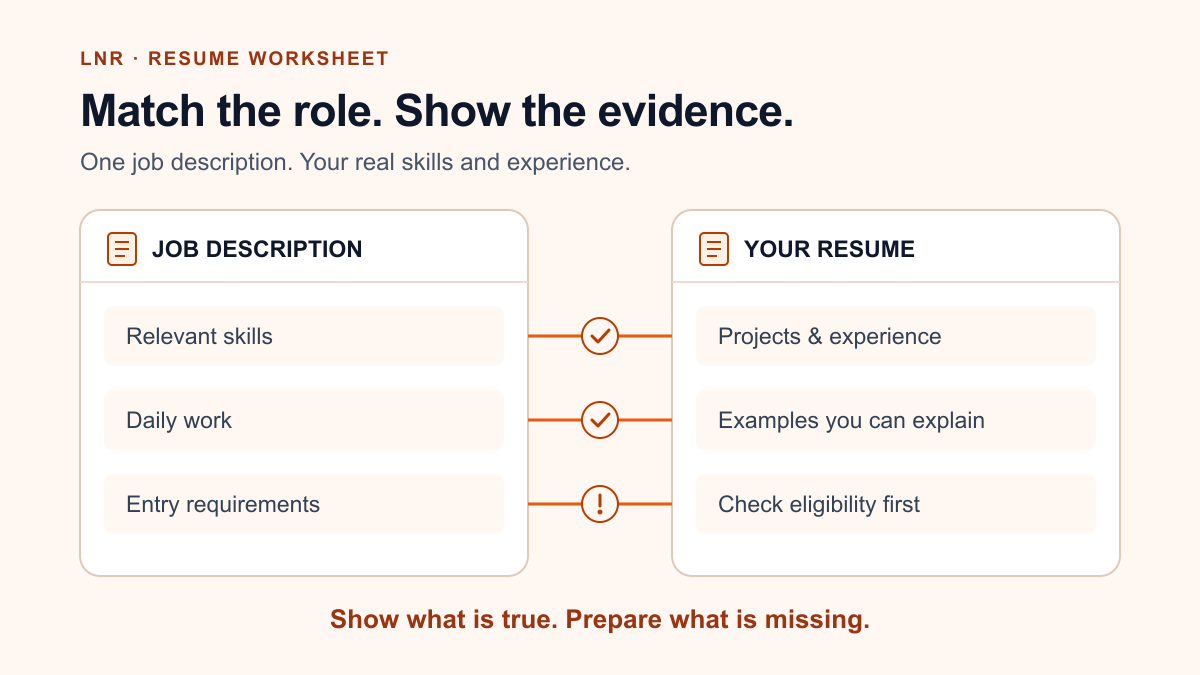
In this guide
- 1
What the job needs
- 2
Examples from your work
- 3
What needs explaining
- 4
What to work on
What should a resume to JD comparison include?
It should identify what the employer states, what the resume shows, and what remains unknown. It should not assume that a missing phrase means missing skill, or that adding a keyword will overcome mandatory eligibility requirements.
Step 1: Confirm eligibility before editing
Find requirements for qualification, graduation year, experience, geography, authorization, language and any special application rules. Note each requirement as mandatory, preferred or unclear. If unclear, consult the official employer notice or ask for clarification.
Step 2: Map the work, not just vocabulary
| Requirement in the JD | Example from my background | Assessment | Honest next action |
|---|---|---|---|
| Basic SQL queries | Queries written for course project | Demonstrated in coursework, not in employment | Explain actual queries and results |
| Dashboard reporting | None yet | Not demonstrated | Build a practice report if relevant |
| Prior professional experience | No employment experience | Does not meet requirement if mandatory | Consider eligible openings |
These are fictional practice rows, not a real candidate assessment.
Step 3: Check if your resume communicates the truth clearly
Can a reviewer tell what you did, which tools you used, why it mattered, and what you know versus what you are learning? Avoid invented percentages, client names, professional experience or credentials. If an outcome was not measured, describe what can be verified instead.
Step 4: Check document clarity
Use clear headings, consistent dates and selectable text. Inspect a copied text version of your file. Different employers use different tools, so this checks general readability, not guaranteed ATS performance.
Step 5: Prioritize changes
Separate changes you can make to the writing from work that needs more learning or practice. Correct anything false or misleading first. Then make the most relevant experience easier to understand.
One page result to keep
Note three requirements you can support, two points you need to clarify, any requirements you do not meet and the edits you can make now. Keep learning or practice tasks on a separate list. Review the notes when you get useful feedback.
Read ATS vs recruiter review for more context, or use the resume review guide to see what a careful comparison can tell you. Related reading: the proposed personalized service.
A worksheet you can complete for one real opening
| Requirement from the employer | Evidence in my resume | Finding | Next action and why |
|---|---|---|---|
| Mandatory degree or location | Exact qualification and location | Supported / not met / unclear | Verify before spending time on cosmetic edits |
| Core task | A project, internship or paid work example | Supported / partly supported / not evident | Surface a real example or build missing capability |
| Tool or method | What you actually used and can explain | Supported / unknown | Clarify truthfully; do not claim a tool you cannot use |
| Communication or teamwork | Your own contribution and audience | Partly supported / not evident | Add a defensible account of what you did |
The labels describe the available documents. They are not a score or a judgment of the whole person.
Worked example: explain the work you actually did
Illustrative junior analyst JD: “Use SQL to check weekly operational data and summarize exceptions.” Illustrative applicant: a BCA graduate who queried a synthetic library dataset for a class assignment. A weak entry says “SQL project.” A stronger, truthful entry could say: “Queried a synthetic library dataset to identify duplicate borrower records; documented the checks and summarized limitations in a class report.” Use that wording only if those actions actually happened. It is still coursework, not employment or a production system.
Decide which change has priority
Start with mandatory eligibility. Then fix anything that makes the document unreadable. Next, reveal high relevance work you genuinely did. After that, identify gaps that require practice or a new sample. Finally, ask a peer to read the resume and tell you which requirement they can actually find. If they cannot find it, revise the explanation; if the work never happened, create the work before claiming it.
Sources and further reading
Keep going
Keep improving your resume
Review Your Resume
Review a resume against one job description. Find unclear evidence, missing requirements and edits you can make honestly.
ATS vs Recruiter Review
Understand parsing, employer screening and human review without relying on a universal ATS score or keyword tricks.
College Projects on a Resume
Show college projects on your resume with a clear scope, your contribution, tools, result and honest limitations.